 Written byAurélien RUMIANO
Introduction
Finally, I was able to make a 3d model of my nasal cavity usable with a CFD software.
For those who don’t know what is CFD, it just mean Computational Fluid Dynamics which is the study of fluids, in our case the air.
I took 15 l/min for the flow rate and I did not apply temperature conditions on the walls.
Just for information each nostril has a surface of around 68 mm² and the beguining of my pharynx 420 mm². And you can see my cross-sectional area here, in my precedent article.
Résultats

Dans cette vue, le flux d'air est représenté par de petits tubes. On peut voir que presque tout le flux d'air passe par le méat moyen, à une vitesse comprise entre 1,5 et 2 m/s. À l'inverse, dans la zone du méat inférieur, il n'y a presque pas de flux d'air et la vitesse est très faible, inférieure à 0,5 m/s. Près des narines, la vitesse est assez élevée dans certaines zones, autour de 3 m/s.

Même chose pour le côté gauche.
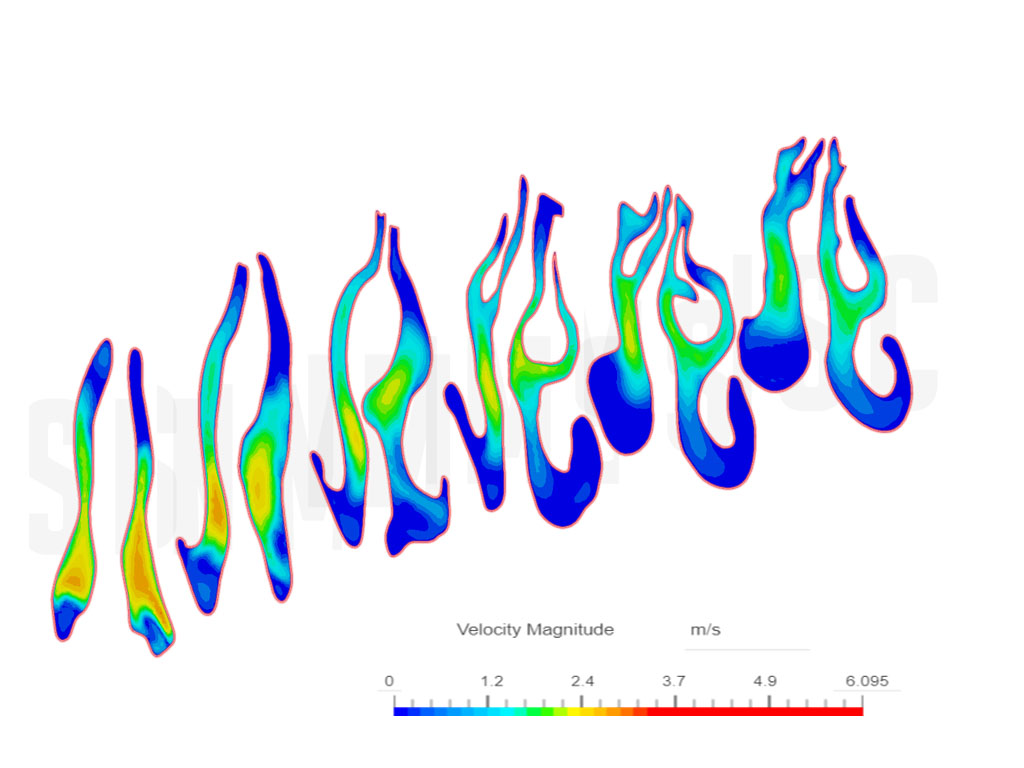
Dans cette vue, la cavité nasale est représentée en coupe : à gauche de l'illustration, elle se trouve près de la narine, et à droite, près du pharynx. Nous voyons uniquement la vitesse, et non la quantité de flux d'air. On peut constater la même chose que dans les autres vues : une vitesse très faible dans le méat inférieur, malgré mon implant sur la paroi nasale droite.
Interprétation des résultats
The results are not very surprising, some studies come to the same conclusion about the airflow distribution. In this study for instance they showed the same thing, an important reduction of the airflow in the inferior meatus (25.8% ± 17.6%) . They also showed a reduction in wall shear stress (WSS) in the inferior meatus area, which is the force of friction on the walls of the mucosa. Less shear stress means less airflow sensation. And I’m not sure but less airflow quantity and less velocity mean less wall shear stress. In my simulation, I was not able to measure the wall shear stress due to software limitations but since the velocity and the airflow are very low in the inferior meatus then we can say that the WSS too. And according to this same study, the symptoms “of “suffocation” and “nose feels too open” were also found to be significantly correlated with peak WSS around the inferior turbinate. So in others words less WSS in the inferior meatus zone mean more symptoms of suffocation and the feeling of the nose too open.

Conclusion et prochaine étape
Maintenant que nous voyons clairement que l’un des problèmes du SNV est la répartition du flux d’air, je vais essayer de corriger cela à l’aide d’implants virtuels placés à différents endroits. Le but est bien sûr de tendre vers une répartition du flux d’air identique à celle d’un nez sain.
Limitations
Just to be clear, I’m not a reasearcher nor a CFD specialist, so the results can be wrong due to many things. If you see an error in the conditions or the reasoning, please can contact me.