 Written byAurélien RUMIANO
Inleiding
Finally, I was able to make a 3d model of my nasal cavity usable with a CFD software.
For those who don’t know what is CFD, it just mean Computational Fluid Dynamics which is the study of fluids, in our case the air.
I took 15 l/min for the flow rate and I did not apply temperature conditions on the walls.
Just for information each nostril has a surface of around 68 mm² and the beguining of my pharynx 420 mm². And you can see my cross-sectional area here, in my precedent article.
Resultaten

In deze weergave wordt de luchtstroom weergegeven door kleine buisjes. We kunnen zien dat vrijwel alle luchtstroom door de middelste neusgang gaat, met een snelheid tussen 1,5 en 2 m/s. In de onderste neusgang daarentegen is vrijwel geen luchtstroom en is de snelheid zeer laag, minder dan 0,5 m/s. Dicht bij de neusgaten is de snelheid in sommige gebieden vrij hoog, rond 3 m/s.

Hetzelfde geldt voor de linkerkant.
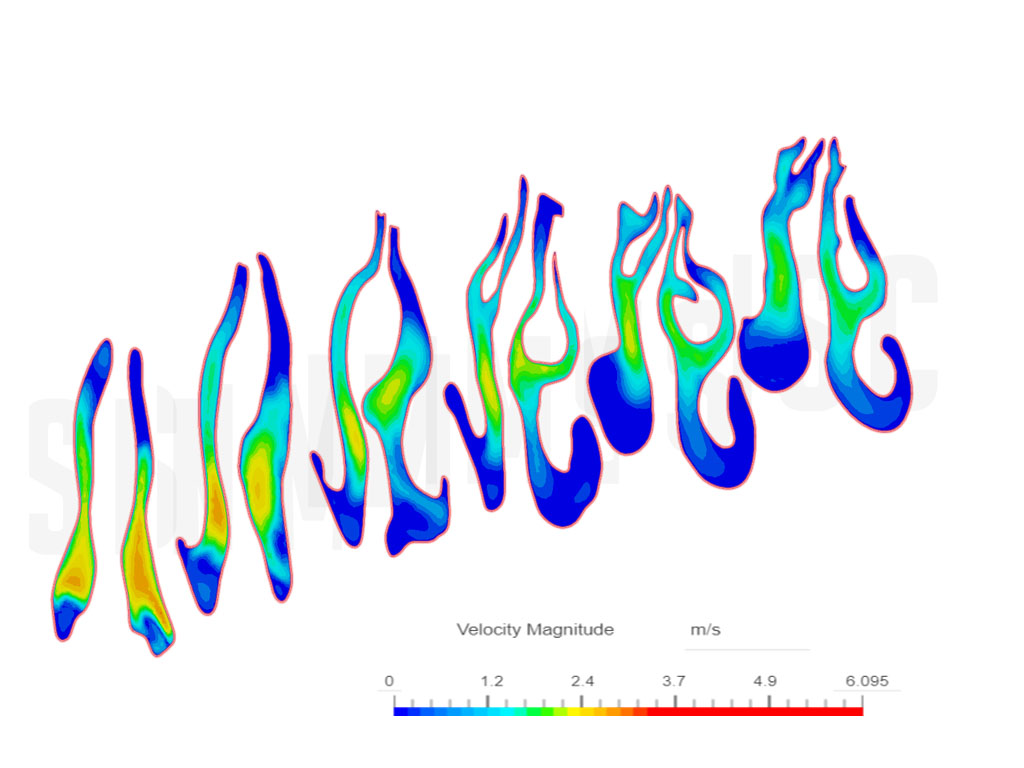
In deze weergave is de neusholte in doorsneden weergegeven: links in de afbeelding bevindt deze zich dicht bij het neusgat en rechts dicht bij de keelholte. We zien alleen de snelheid, niet de hoeveelheid luchtstroom. We zien hetzelfde als in de andere weergaven: een zeer lage snelheid in de onderste neusgang, ondanks mijn implantaat tegen de rechterneuswand.
Interpretatie van de resultaten
The results are not very surprising, some studies come to the same conclusion about the airflow distribution. In this study for instance they showed the same thing, an important reduction of the airflow in the inferior meatus (25.8% ± 17.6%) . They also showed a reduction in wall shear stress (WSS) in the inferior meatus area, which is the force of friction on the walls of the mucosa. Less shear stress means less airflow sensation. And I’m not sure but less airflow quantity and less velocity mean less wall shear stress. In my simulation, I was not able to measure the wall shear stress due to software limitations but since the velocity and the airflow are very low in the inferior meatus then we can say that the WSS too. And according to this same study, the symptoms “of “suffocation” and “nose feels too open” were also found to be significantly correlated with peak WSS around the inferior turbinate. So in others words less WSS in the inferior meatus zone mean more symptoms of suffocation and the feeling of the nose too open.

Conclusie en volgende stap
Nu we duidelijk zien dat een van de problemen bij ENS de verdeling van de luchtstroom is, zal ik proberen dit te verhelpen met enkele virtuele implantaten die op verschillende plaatsen worden aangebracht. Het doel is natuurlijk om dezelfde verdeling van de luchtstroom als bij een gezonde neus te benaderen.
Beperkingen
Just to be clear, I’m not a reasearcher nor a CFD specialist, so the results can be wrong due to many things. If you see an error in the conditions or the reasoning, please can contact me.