 Written byAurélien RUMIANO
Introducción
Finally, I was able to make a 3d model of my nasal cavity usable with a CFD software.
For those who don’t know what is CFD, it just mean Computational Fluid Dynamics which is the study of fluids, in our case the air.
I took 15 l/min for the flow rate and I did not apply temperature conditions on the walls.
Just for information each nostril has a surface of around 68 mm² and the beguining of my pharynx 420 mm². And you can see my cross-sectional area here, in my precedent article.
Resultados

En esta vista, el flujo de aire está representado por pequeños tubos. Podemos ver que casi todo el flujo de aire pasa por el meato medio a una velocidad de entre 1,5 y 2 m/s. Por el contrario, en la zona del meato inferior casi no hay flujo de aire y la velocidad es muy baja, menos de 0,5 m/s. Cerca de las fosas nasales, en algunas zonas, la velocidad es bastante alta, de alrededor de 3 m/s.

Lo mismo ocurre en el lado izquierdo.
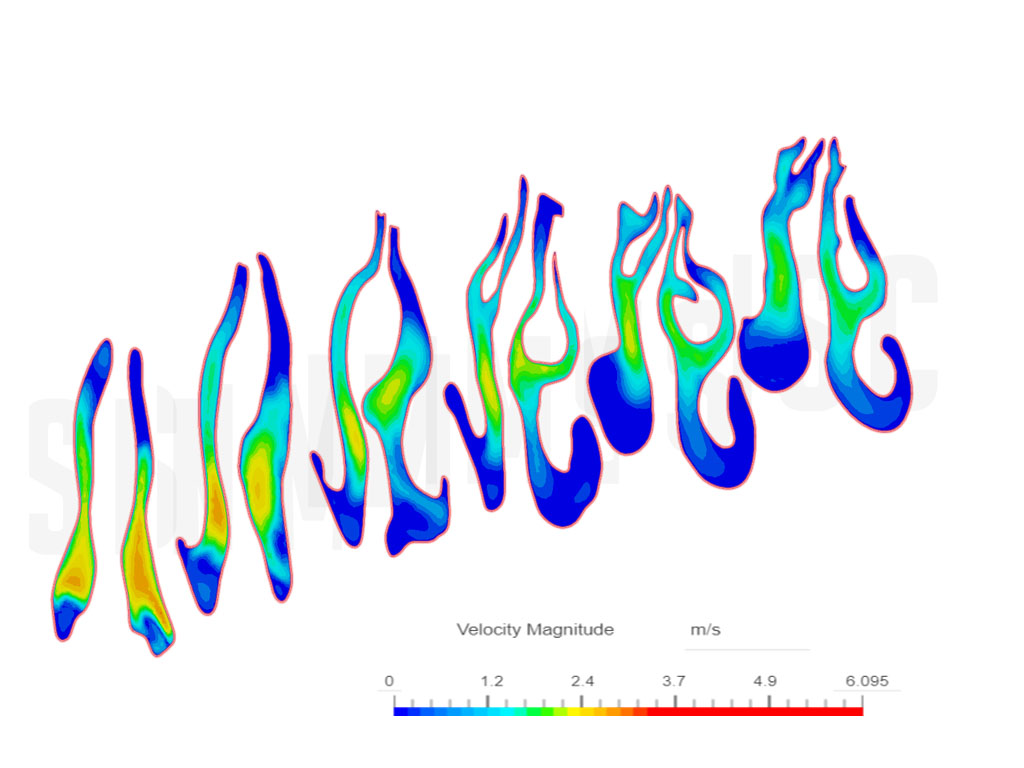
En esta vista, la cavidad nasal está cortada; a la izquierda de la ilustración está cerca de la fosa nasal y a la derecha, cerca de la faringe. Solo vemos la velocidad, no la cantidad de flujo de aire, y podemos observar lo mismo que en las otras vistas: una velocidad muy baja en el meato inferior a pesar de mi implante en la pared nasal derecha.
Interpretación de los resultados
The results are not very surprising, some studies come to the same conclusion about the airflow distribution. In this study for instance they showed the same thing, an important reduction of the airflow in the inferior meatus (25.8% ± 17.6%) . They also showed a reduction in wall shear stress (WSS) in the inferior meatus area, which is the force of friction on the walls of the mucosa. Less shear stress means less airflow sensation. And I’m not sure but less airflow quantity and less velocity mean less wall shear stress. In my simulation, I was not able to measure the wall shear stress due to software limitations but since the velocity and the airflow are very low in the inferior meatus then we can say that the WSS too. And according to this same study, the symptoms “of “suffocation” and “nose feels too open” were also found to be significantly correlated with peak WSS around the inferior turbinate. So in others words less WSS in the inferior meatus zone mean more symptoms of suffocation and the feeling of the nose too open.

Conclusión y siguiente paso
Ahora que vemos claramente que uno de los problemas del ENS es la distribución del flujo de aire, intentaré corregirlo con algunos implantes virtuales colocados en distintas zonas. El objetivo, por supuesto, es acercarse a la misma distribución del flujo de aire que en una nariz sana.
Limitaciones
Just to be clear, I’m not a reasearcher nor a CFD specialist, so the results can be wrong due to many things. If you see an error in the conditions or the reasoning, please can contact me.