 Written byAurélien RUMIANO
Introduzione
Finally, I was able to make a 3d model of my nasal cavity usable with a CFD software.
For those who don’t know what is CFD, it just mean Computational Fluid Dynamics which is the study of fluids, in our case the air.
I took 15 l/min for the flow rate and I did not apply temperature conditions on the walls.
Just for information each nostril has a surface of around 68 mm² and the beguining of my pharynx 420 mm². And you can see my cross-sectional area here, in my precedent article.
Risultati

In questa vista, il flusso d'aria è rappresentato da piccoli tubi. Possiamo vedere che quasi tutto il flusso d'aria passa attraverso il meato medio, a una velocità compresa tra 1,5 e 2 m/s. Al contrario, nella zona del meato inferiore, c'è quasi assenza di flusso d'aria e la velocità è molto bassa, inferiore a 0,5 m/s. Vicino alle narici, in alcune zone, la velocità è piuttosto elevata, circa 3 m/s.

La stessa cosa vale per il lato sinistro.
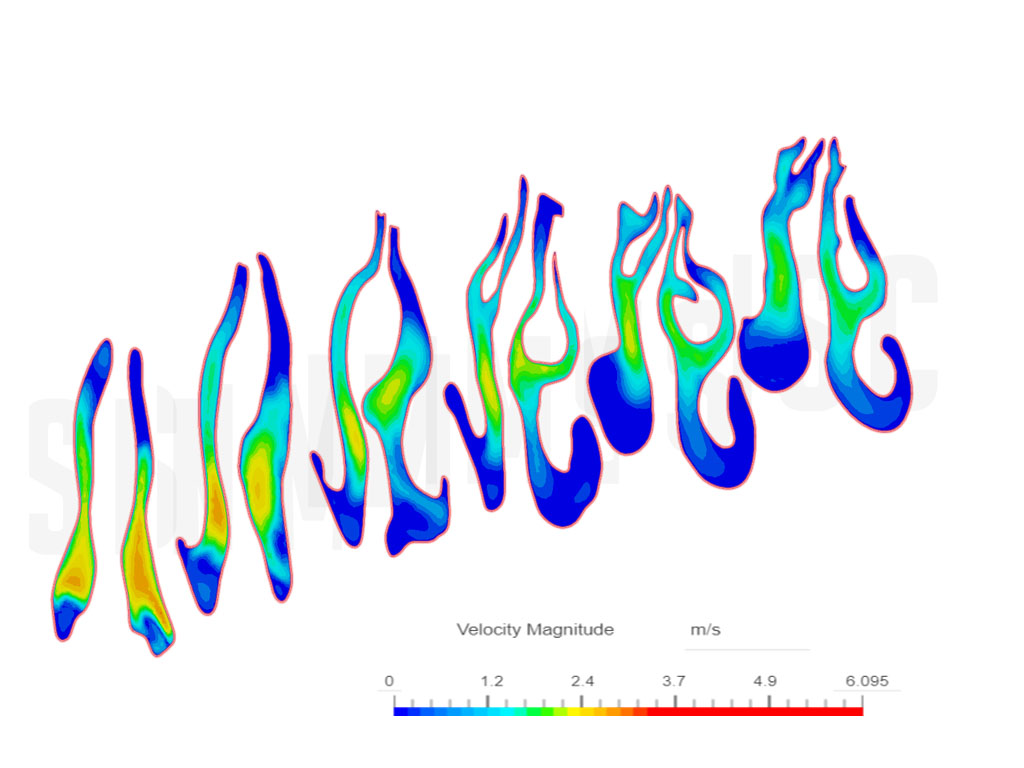
In questa vista, la cavità nasale è sezionata: a sinistra dell'illustrazione è vicina alla narice, mentre a destra è vicina alla faringe. Vediamo solo la velocità, non la quantità di flusso d'aria, e possiamo osservare la stessa cosa delle altre viste: una velocità molto bassa nel meato inferiore nonostante il mio impianto sulla parete nasale destra.
Interpretazione dei risultati
The results are not very surprising, some studies come to the same conclusion about the airflow distribution. In this study for instance they showed the same thing, an important reduction of the airflow in the inferior meatus (25.8% ± 17.6%) . They also showed a reduction in wall shear stress (WSS) in the inferior meatus area, which is the force of friction on the walls of the mucosa. Less shear stress means less airflow sensation. And I’m not sure but less airflow quantity and less velocity mean less wall shear stress. In my simulation, I was not able to measure the wall shear stress due to software limitations but since the velocity and the airflow are very low in the inferior meatus then we can say that the WSS too. And according to this same study, the symptoms “of “suffocation” and “nose feels too open” were also found to be significantly correlated with peak WSS around the inferior turbinate. So in others words less WSS in the inferior meatus zone mean more symptoms of suffocation and the feeling of the nose too open.

Conclusioni e prossimo passo
Ora che vediamo chiaramente che uno dei problemi dell'ENS è la distribuzione del flusso d'aria, proverò a correggerla con alcuni impianti virtuali posizionati in aree diverse. L'obiettivo, naturalmente, è tendere verso la stessa distribuzione del flusso d'aria di un naso sano.
Limitazioni
Just to be clear, I’m not a reasearcher nor a CFD specialist, so the results can be wrong due to many things. If you see an error in the conditions or the reasoning, please can contact me.