
What is HRV?
HRV (Heart Rate Variability) is the measurement of the variation in time (in milliseconds) between two consecutive heartbeats.
A high HRV reflects the autonomic nervous system's ability to switch flexibly between "stress" mode (sympathetic) and "recovery" mode (parasympathetic). Therefore, HRV is an excellent indicator of the overall stress level our body is facing.
There is also a direct link between HRV, sleep quality, and depression [1] [2]. HRV influences sleep, and sleep influences HRV. Indeed, better sleep quality increases HRV and lowers the resting heart rate the following day. Conversely, a high HRV improves sleep quality—especially deep sleep—the following night.
Several studies also link HRV to depression; individuals experiencing depression often have low HRV. A low HRV is frequently a sign of a "loss of vagal flexibility." Essentially, the body stays stuck in "survival" mode (sympathetic) and can no longer activate the "brake" (parasympathetic) to soothe itself. This explains why one might feel less depressed when HRV improves: the body has regained its physiological ability to calm down. It is, therefore, a strong indicator of resilience [3].
How to track it?
You don’t need medical-grade equipment to monitor your HRV. It can be measured with almost any modern smartwatch or fitness tracker, such as Apple Watch, Fitbit, Samsung Galaxy Watch, Garmin, or Whoop for example.
My Experience
This is anecdotal, but I experienced it recently. I lately implemented a system to increase my HRV. I am 36 years old, and I went from approximately 50 ms to 70 ms in one week. And indeed, although I don't necessarily feel like I'm sleeping better, I am slightly less tired and, above all, less depressed.
It remains to be seen if this trend continues over time and if I can maintain this value, which I suspect will not be an easy task.
How to Increase Your HRV?
So, how do you increase your HRV in practice?
- Regular Physical Activity: Exercise regularly, but stay within what your body can handle. After a heavy workout, HRV can drop due to the physical stress placed on the system. It can take a few days to recover; thus, HRV is also a great indicator of overtraining.
- Sleep: Try to sleep as long and as well as possible, which I know is difficult for those of us suffering from ENS.
- Nutrition: Do not consume more calories than your body can process.
- Meal Timing: Eat your last meal at least 4 hours before bed, and keep it light. To optimize sleep quality and fall asleep easier, you don't want your body digesting while you start your night. Digestion disrupts sleep, delays the onset of deep sleep, and degrades its overall quality.
Even if you are thin and looking to gain weight, do not force yourself to overeat. This will lower your HRV, which in turn lowers your sleep quality and, eventually, reduces your digestive capacity. It becomes a vicious cycle of metabolic stress. If the body spends the night digesting, it isn't spending the night repairing the nervous system.
You can create a virtuous cycle: eating slightly below your maximum digestive capacity increases HRV, which improves sleep quality and, ultimately, boosts your digestive capacity the next day.
Conclusion
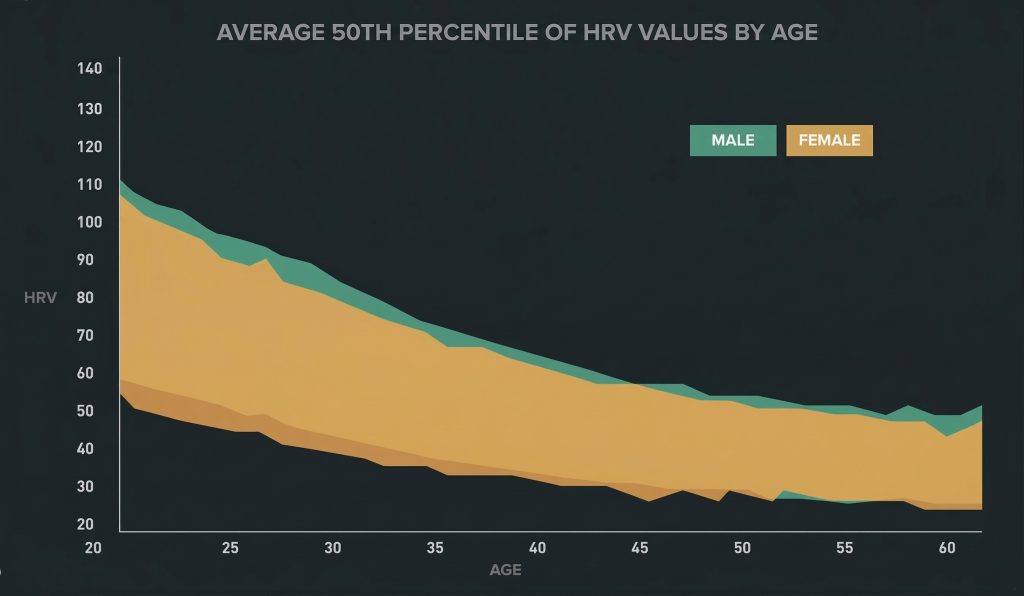
HRV is a reliable indicator of physical stress and is very useful for monitoring your general health. To give you an idea of typical values, here is a chart showing HRV relative to age.
References
- Reduced heart rate variability predicts poor sleep quality in a case–control study of chronic fatigue syndrome
Link - Heart Rate Variability, Sleep Quality, and Depression in the Context of Chronic Stress
Link - Heart rate variability (HRV) as a way to understand associations between the autonomic nervous system (ANS) and affective states: A critical review of the literature.
Link